

Interchange-Plus vs. Tiered vs. Flat Rate Pricing: Which Model Actually Costs You Less?
Most business owners assume all payment processors charge roughly the same rates. In reality, the pricing structure behind your payment processing account can dramatically affect how much your business pays every month.

A processor advertising a low rate may still cost significantly more depending on how transactions are categorized, how fees are bundled, and how transparent the pricing model is.
For grocery stores, convenience stores, retail businesses, and restaurants operating on tight margins, understanding payment pricing structures is critical. Even small differences in transaction costs can add up to thousands of dollars annually.
The three most common payment processing models are interchange plus pricing, tiered pricing, and flat rate pricing. While all three allow businesses to accept card payments, they work very differently behind the scenes.
Some focus on simplicity. Others focus on transparency. Some are better suited for low-volume businesses, while others provide stronger long-term savings for growing retailers.
This guide explains how each model works, what businesses should watch for, and which pricing structure usually delivers the best value over time.
What Is Interchange Plus Pricing?
Interchange plus pricing is a payment processing model where merchants pay the actual interchange fee determined by card networks plus a fixed markup added by the processor.
The interchange fee is the base cost established by payment networks and issuing banks. The processor then adds its own clearly disclosed markup on top of that fee.
For example, if the interchange fee for a transaction is 1.80% and the processor adds 0.30%, the total processing rate becomes 2.10%.
This pricing model is considered one of the most transparent options because businesses can clearly see the following:
The true interchange cost
The processor’s markup
Additional service fees
Unlike bundled pricing structures, interchange plus pricing separates each cost component, making monthly statements easier to audit and understand.
Many medium and high-volume businesses prefer this model because it often produces lower effective processing rates over time.
What Is Tiered Pricing?
Tiered pricing groups transactions into categories such as qualified, mid-qualified, and non-qualified transactions. Each category has its own processing rate.
At first glance, this model may appear straightforward because processors advertise an attractive low “qualified rate.” However, many transactions end up falling into more expensive categories.
For example:
Debit cards may qualify for the lowest rate
Rewards cards may process at higher rates
Manually entered transactions may become non-qualified
The biggest challenge with tiered pricing is that processors control how transactions are classified. This often creates confusion for business owners reviewing monthly statements.
A transaction that appears simple may suddenly process at a significantly higher cost without the merchant fully understanding why.
Over time, businesses may discover that their actual processing expenses are much higher than the originally advertised rate.
What Is Flat Rate Pricing?
Flat rate pricing charges the same processing fee for every transaction regardless of card type or interchange category.
For example, a provider may charge the following:
2.6% + 10¢ for all in-store payments
2.9% for online payments
This pricing structure is popular among startups and smaller businesses because it is simple and predictable. Business owners know exactly what they will pay for each transaction without needing to analyze complex statements.
Flat-rate pricing often works well for:
Small retailers
Mobile vendors
Seasonal businesses
Companies with lower transaction volume
However, businesses processing larger monthly sales volume may eventually overpay because the processor’s markup is built into every transaction.
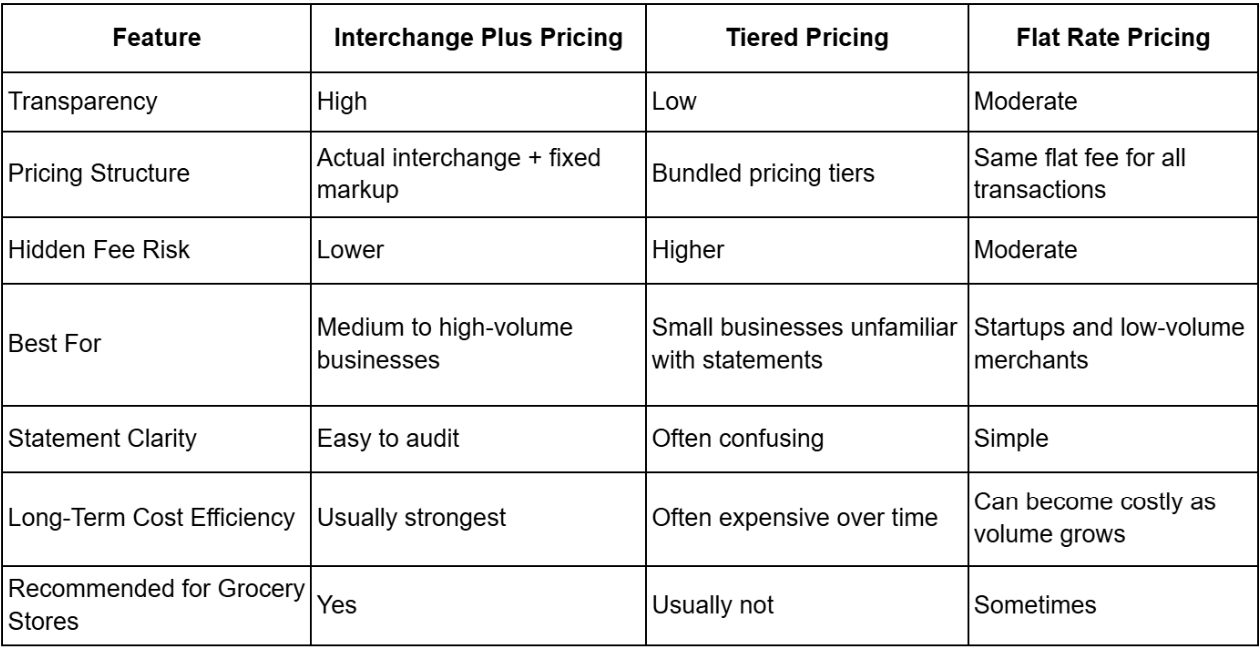
Why Pricing Structure Matters More Than Advertised Rates
Many businesses choose processors based only on promotional percentages. That approach can be misleading.
A processor advertising a low rate may still charge the following:
Hidden service fees
Higher non-qualified transaction rates
PCI compliance charges
Equipment costs
Gateway fees
The pricing structure itself determines how transparent and predictable your monthly processing costs will be.
Businesses that fail to understand their pricing model often struggle to identify the following:
Unnecessary charges
Inflated transaction categories
Long-term fee increases
This is why understanding how pricing works is often more important than comparing headline rates alone.
What Different Pricing Models Can Actually Cost Your Business
Understanding pricing structures becomes much easier when you look at real-world numbers.
For example, imagine a grocery store processing approximately $150,000 per month in card transactions.
On a tiered pricing model with an effective processing rate of 3.2%, the business could pay roughly:
$4,800 per month in processing fees
More than $57,000 annually
On an interchange plus pricing model with an effective rate closer to 1.9%, that same business might pay:
Approximately $2,850 per month
Around $34,200 annually
That difference equals nearly $24,000 per year in potential savings.
For grocery stores, convenience retailers, and supermarkets operating on narrow margins, understanding effective processing rates can have a significant impact on long-term profitability.
Why Many Businesses Prefer Interchange Plus Pricing
One reason interchange plus pricing remains popular among growing retailers is that it gives businesses better visibility into their true effective processing costs.
Instead of relying on bundled pricing categories, merchants can review monthly statements more clearly and identify:
Processor markups
Interchange costs
Additional monthly fees
Potential hidden charges
Businesses reviewing their payment provider should also verify whether they are truly on an interchange plus pricing model or a bundled pricing structure disguised as transparent pricing.
Important questions merchants should ask include:
Are interchange fees listed separately?
Is the processor markup clearly disclosed?
Are transactions grouped into pricing tiers?
Are there unexpected service charges or statement fees?
Understanding these details helps businesses compare providers more accurately and identify opportunities to reduce unnecessary long-term processing expenses.
Get a Free Payment Processing Statement AnalysisWant to know which pricing model you're actually on—and whether it's costing your business more than it should?
QSS will review your payment processing statement for free and explain in plain English what you're paying, where unnecessary fees may exist, and whether a more transparent pricing structure could reduce long-term costs.
The Problems With Tiered Pricing
Tiered pricing remains common throughout the payment industry because it allows processors greater flexibility in transaction classification.
Unfortunately, that flexibility often benefits the processor more than the merchant.
Many businesses discover that:
Most transactions process at higher tiers
Statements are difficult to interpret
Advertised rates apply only to limited transaction types
This lack of transparency makes it difficult for business owners to understand their true processing costs.
In some cases, merchants may believe they are receiving competitive rates while actually paying significantly more than businesses using interchange plus pricing.
When Flat Rate Pricing Makes Sense
Flat rate pricing is not always a poor choice. For some businesses, simplicity matters more than fee optimization.
Small businesses with limited transaction volume may benefit from:
Predictable monthly costs
Simplified statements
Faster onboarding
Easier budgeting
However, as businesses grow, flat rate pricing often becomes more expensive because the markup remains built into every transaction regardless of card type.
Many growing retailers eventually transition to interchange plus pricing once monthly sales volume increases enough to justify a more transparent pricing structure.
What Is My Effective Rate and How Do I Calculate It?
Your effective processing rate is the total amount paid in processing fees divided by your total monthly card sales volume.
For example, if your business processes $100,000 in monthly card payments and pays $2,900 in total fees, your effective processing rate would be 2.9%.
Understanding your effective rate helps businesses compare pricing structures more accurately and identify whether hidden fees or inflated transaction categories are increasing overall costs.
Which Pricing Model Usually Costs Less?
For most medium and high-volume businesses, interchange plus pricing usually provides the lowest long-term processing costs.
This is largely because:
Processor markups remain transparent
Transactions are not grouped into inflated pricing categories
Effective processing rates are often lower
Flat rate pricing may still make sense for small businesses seeking simplicity, while tiered pricing frequently becomes the least transparent and most expensive option over time.
The best choice ultimately depends on:
Transaction volume
Average ticket size
Industry type
Operational complexity
However, businesses focused on long-term cost control often prefer interchange plus pricing because of its transparency and scalability.
Why Grocery Stores Need Transparent Pricing
Grocery stores process extremely high transaction volume while operating on narrow profit margins. This makes payment processing efficiency especially important.
For grocery stores and supermarket owners in New Jersey and the New York City metro area, payment processing transparency becomes even more important. High transaction volume, competitive margins, and state-specific payment regulations can significantly affect long-term processing costs and operational profitability.
Even a small increase in processing costs can significantly impact annual profitability.
At the same time, grocery stores often handle:
Debit cards
Credit cards
EBT payments
Contactless transactions
Multi-lane checkout operations
Without transparent pricing, unnecessary fees can quietly accumulate month after month.
This is why many grocery retailers prioritize integrated POS systems and payment environments that improve visibility into transaction costs.
Inventory visibility is equally important for retailers. Businesses that struggle with stock accuracy, manual inventory processes, or limited reporting often discover that operational inefficiencies can affect profitability just as much as payment processing costs.
How Modern POS Systems Support Better Payment Efficiency
Modern POS systems do far more than process transactions.
Businesses evaluating payment processing costs should also consider whether their current POS platform is supporting long-term operational growth. Choosing the right POS system can improve reporting visibility, inventory management, and payment efficiency while reducing operational bottlenecks.
Integrated platforms help businesses improve:
Reporting visibility
Inventory tracking
Payment reconciliation
Transaction accuracy
Operational efficiency
Outdated systems may increase manual errors, transaction downgrades, and maintenance expenses that contribute to higher processing costs.
Solutions like Clover and Shift4 help retailers modernize payment operations while improving system reliability and transparency.
How QSS Helps Retailers Improve Payment Processing
QSS works with grocery stores, convenience stores, and retailers to simplify payment processing and improve POS infrastructure.
As a reseller and technology partner, QSS helps businesses evaluate:
Existing payment costs
Hardware limitations
Reporting inefficiencies
Hidden processing fees
By implementing trusted solutions such as Clover and Shift4, QSS helps retailers create more transparent and scalable payment environments.
For example, one independent grocery retailer processing more than $180,000 per month in card transactions upgraded from a disconnected legacy payment environment to a more transparent integrated POS system supported by QSS. After reviewing its pricing structure and processing costs, the retailer reduced its effective processing expenses and achieved estimated annual savings of more than $8,000 while also improving reporting visibility and checkout efficiency.
In another case, a convenience retailer operating multiple checkout lanes consolidated separate payment tools into one centralized payment environment. By simplifying reporting and improving pricing transparency, the business reduced unnecessary processing costs and operational inefficiencies, resulting in estimated annual savings of approximately $5,000.
Because QSS is a reseller rather than a proprietary POS brand, businesses gain flexibility when choosing systems that match their operational goals and long-term growth plans.
Final Thoughts
Choosing the right payment pricing model can significantly affect your business’s profitability.
While flat rate pricing offers simplicity and tiered pricing remains common, interchange plus pricing continues to be the preferred option for many growing retailers because of its transparency and long-term cost advantages.
Understanding your true effective processing cost is far more important than focusing only on advertised rates.
Businesses that review statements carefully, modernize outdated systems, and prioritize transparent payment structures are often better positioned to reduce hidden fees and improve operational efficiency over time.
Find Out If You're on the Right Pricing Model - For Free
QSS helps grocery stores and retailers modernize payment systems with transparent pricing structures, integrated POS solutions, and scalable payment technology.
Whether your business is reviewing interchange plus pricing, replacing outdated hardware, or implementing solutions like Clover and Shift4, QSS can help create a more efficient and cost-effective payment environment.
Send us your latest payment processing statement via contactus@qsspos.com and we'll explain which pricing model you're currently on, what it's actually costing your business, and whether there may be opportunities to reduce unnecessary fees. There's no cost, no obligation, and no confusing industry jargon - just a clearer understanding of your payment processing expenses.
FAQs
What is interchange plus pricing?
Interchange plus pricing is a payment processing model where businesses pay the actual interchange fee charged by card networks plus a separate processor markup. This structure gives merchants better visibility into transaction costs and helps businesses understand exactly what portion of the fee goes to the processor. Many retailers prefer this pricing model because it offers greater transparency and often lower long-term processing expenses.
How does tiered pricing work?
Tiered pricing groups transactions into categories such as qualified, mid-qualified, and non-qualified rates. Each category carries different processing costs depending on the transaction type and card used. Because processors determine transaction classification, businesses may pay higher rates than expected. This pricing structure can make statements more difficult to understand and often reduces visibility into actual processing expenses.
What is flat rate payment processing?
Flat rate payment processing charges the same fee for every transaction regardless of card type or interchange category. This model is popular among smaller businesses because it simplifies budgeting and provides predictable transaction costs. However, businesses processing larger monthly sales volume may eventually overpay because processor markups are included within every transaction instead of being separated transparently like interchange plus pricing.
Which pricing model is usually the cheapest?
For most medium and high-volume businesses, interchange plus pricing generally provides the lowest long-term processing costs because the processor markup remains transparent and transactions are not grouped into inflated pricing tiers. Flat rate pricing may work well for smaller businesses seeking simplicity, while tiered pricing often becomes more expensive over time due to inconsistent transaction categorization and limited pricing transparency.
Why do businesses prefer interchange plus pricing?
Businesses often prefer interchange plus pricing because it clearly separates interchange fees from processor markups, making monthly statements easier to understand and audit. This transparency allows merchants to compare providers more accurately and identify unnecessary fees more quickly. Retailers processing high transaction volume frequently choose interchange plus pricing because even small reductions in processing costs can significantly improve profitability over time.
Is interchange plus pricing better for grocery stores?
Interchange plus pricing is commonly recommended for grocery stores because these businesses process large transaction volume while operating on very narrow margins. Transparent pricing helps grocery retailers understand their true payment costs and avoid inflated transaction categories associated with tiered pricing. Since grocery stores handle thousands of monthly card payments, even small processing savings can create substantial annual financial benefits.
Are hidden fees more common with tiered pricing?
Yes, hidden fees and unexpected charges are often more common with tiered pricing because processors control how transactions are categorized into pricing tiers. Many businesses do not fully understand why certain transactions process at higher rates. This lack of transparency can lead to inflated monthly expenses over time, making it difficult for merchants to accurately monitor and reduce payment processing costs.
Can flat rate pricing become expensive over time?
Flat rate pricing may become expensive as transaction volume grows because the processor markup is built into every payment regardless of interchange costs. While this model simplifies payment processing for smaller businesses, retailers handling larger monthly sales volume often discover they could achieve lower effective rates through interchange plus pricing. Regular statement reviews help businesses determine whether their current pricing model remains cost-effective.
How do POS systems affect payment processing costs?
POS systems directly affect transaction accuracy, reporting quality, and payment processing efficiency. Outdated systems may increase transaction downgrades, maintenance expenses, and operational inefficiencies that raise overall processing costs. Modern integrated platforms such as Clover and Shift4 help retailers improve reporting visibility, streamline operations, and reduce unnecessary payment-related inefficiencies.
How does QSS help businesses improve payment processing?
QSS helps grocery stores and retailers improve payment processing by identifying hidden fees, evaluating current systems, and implementing integrated POS and payment technologies. As a reseller and technology partner, QSS works with trusted solutions like Clover and Shift4 to help businesses improve transparency, reduce inefficiencies, and create scalable payment environments that support long-term operational growth.