

Comparing Toast, Square, and full-service POS for your grocery or retail store? See which system fits your operations and supports long-term growth.
Choosing the right POS system for your grocery or retail store is not just about features. It is about selecting a system that fits your operations, supports your growth, and does not slow you down during peak hours.
Many grocery and retail businesses start with simpler POS systems before realizing their operational needs require stronger inventory management, reporting visibility, and long-term scalability. Choosing the right POS platform depends on transaction volume, inventory complexity, and how the business plans to grow over time.
Understanding where each system performs well and where it falls short can help you avoid costly mistakes.
This guide breaks down the differences between Toast, Square, and Full-Service POS systems so you can make the right decision for your business.
Understanding the Different Types of POS Systems
Not all POS systems are built for the same purpose.
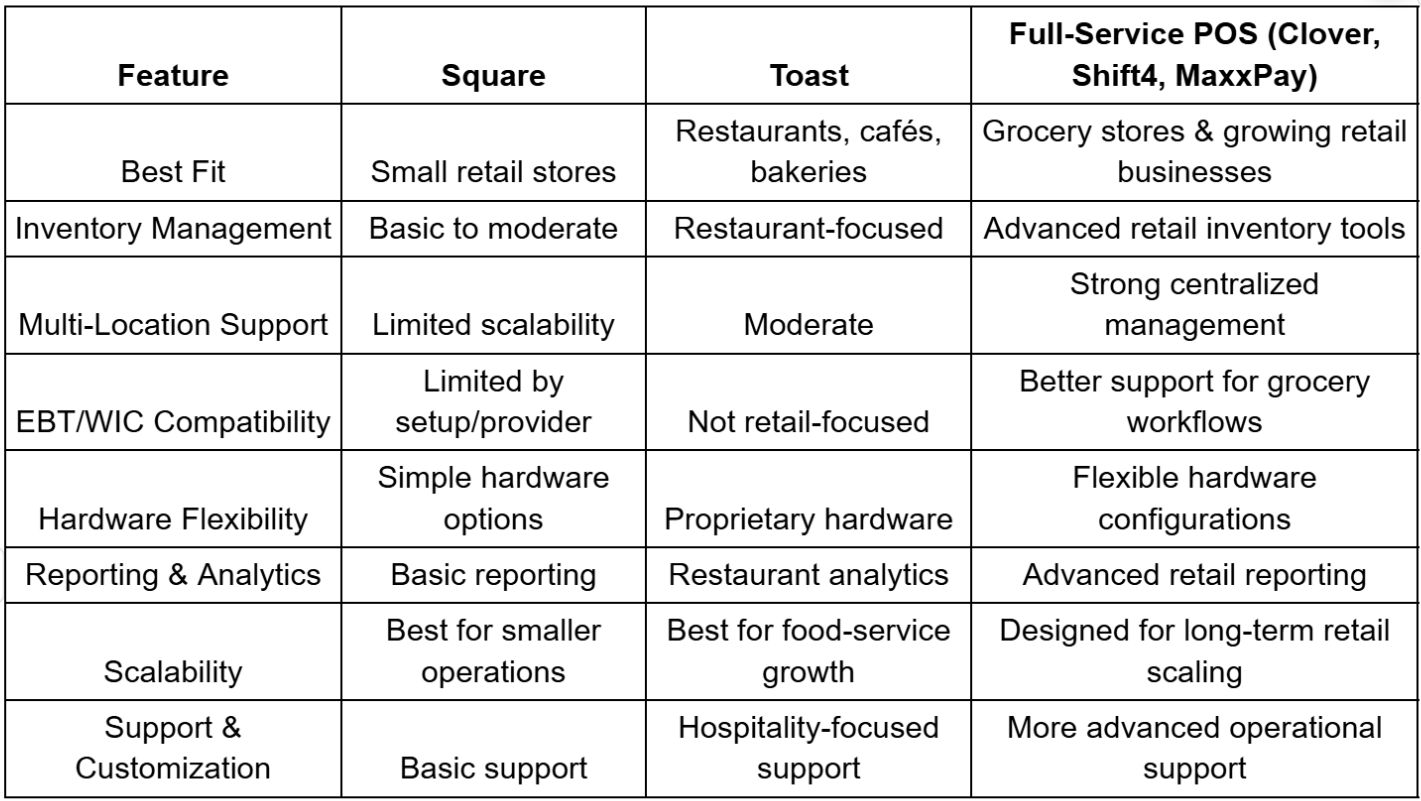
Square is designed for simplicity and flexibility, Toast is built for restaurant operations, and Full-Service POS systems are designed for complex, high volume environments.
Choosing the wrong system can lead to slower operations, limited functionality, and long-term inefficiencies.
Square POS for Retail: Best for Simplicity and Speed
Square is commonly used by smaller retail businesses looking for a simpler POS setup with lower upfront complexity.
Where Square Works Well
Square is often popular among smaller retail businesses because it is relatively simple to set up and does not require extensive technical experience. Many independent retailers choose Square because of its lower upfront costs, integrated payment processing, and straightforward user interface. For single-location stores with lighter inventory requirements, the platform can provide a fast and manageable way to handle transactions, inventory tracking, and day-to-day operations without a complicated implementation process.
Where Square Falls Short
As retail operations grow, some businesses begin to encounter limitations with Square’s inventory depth and operational flexibility. Stores with large SKU counts, multiple locations, or more advanced reporting needs may require stronger inventory controls and customization options than basic systems can easily provide. During higher transaction periods, growing retailers may also need more scalable infrastructure and operational support to maintain consistent performance across locations.
Toast POS: Built for Restaurants, Not Retail
Toast is a powerful system, but it is designed specifically for food service environments.
Where Toast Works Well
Toast is primarily designed for restaurant and hospitality environments where menu management, kitchen coordination, and food ordering workflows are central to daily operations. While some cafés, bakeries, and hybrid food-service businesses may consider Toast, retail-heavy operations often require more advanced inventory visibility and operational flexibility as they grow.
Where Toast Falls Short for Retail
For traditional grocery and retail businesses, Toast may introduce limitations because the system is primarily designed around restaurant operations rather than retail inventory management. Businesses with larger product catalogs, barcode-driven workflows, and multi-department retail operations may find the platform less flexible for their long-term needs. Toast also relies heavily on proprietary hardware and restaurant-focused configurations, which can increase costs and reduce flexibility for non-restaurant environments.
Full-Service POS Systems: Built for Scale and Complexity
Full-service POS systems such as Clover, Shift4, and MaxxPay are typically better suited for grocery stores and growing retail businesses that require stronger inventory management, reporting visibility, multi-location support, and long-term operational scalability.
Where Full-Service POS Excels
Full-service POS platforms are typically designed to support businesses with more demanding operational requirements. Grocery stores and larger retailers often rely on these systems because they can manage high SKU counts, centralized reporting, multi-location inventory visibility, and more advanced transaction workflows. Systems such as Clover, Shift4, and MaxxPay also support stronger integrations with payment processing, eCommerce tools, and operational reporting, helping retailers manage growth more efficiently across different parts of the business.
Where Full-Service POS Requires Consideration
While full-service POS systems provide stronger scalability and operational flexibility, they also require a more structured implementation process compared to entry-level platforms. Businesses may need additional setup, staff training, hardware planning, and technical support during deployment. However, many growing retailers view this investment as worthwhile because it provides stronger long-term reliability, reporting capabilities, and operational control as the business expands.
Need Help Choosing the Right POS System for Your Store? QSS helps grocery and retail businesses evaluate POS systems based on transaction volume, inventory complexity, reporting needs, and long-term growth goals. Choosing the right system early can help prevent operational limitations as your business grows.
Key Differences That Matter for Grocery and Retail Stores
When comparing POS systems, focus on what impacts your daily operations.
Inventory Management
Square works well for businesses with smaller and less complicated inventory needs, but larger grocery operations may eventually outgrow its capabilities as SKU counts increase. Toast is designed primarily for restaurant workflows, so its inventory tools are not optimized for retail-heavy environments. Full-service POS platforms such as Clover, Shift4, and MaxxPay typically provide more advanced inventory visibility, reporting, and automation features that support larger retail operations and multi-location businesses. Many retailers also integrate technologies such as electronic shelf labels and digital signage to improve pricing accuracy, reduce manual updates, and support more efficient in-store operations.
Multi-Location Operations
Businesses operating multiple stores often require centralized reporting, inventory synchronization, and consistent pricing management across locations. While Square can support smaller multi-location setups, larger retail operations may require more advanced controls and customization. Full-service POS systems are generally designed to support growing businesses with more complex operational requirements across multiple stores.
Hardware and Flexibility
Square offers relatively simple hardware options that are easy for smaller businesses to deploy quickly. Toast relies heavily on proprietary hardware designed specifically for restaurant environments, which may limit flexibility for some retailers. Full-service POS environments often provide broader hardware compatibility and customization options depending on the operational needs of the business.
Scalability and Long-Term Growth
Many smaller retailers initially choose simple POS systems because they are easy to set up and cost-effective in the short term. However, as transaction volume, reporting requirements, and inventory complexity grow, businesses often require more scalable systems that can support long-term operational growth. Full-service platforms are typically built with this type of expansion in mind.
Pricing and Long-Term Cost Considerations
Pricing structure is another important factor when evaluating POS systems. Square is often attractive to smaller businesses because it offers a lower-cost entry point with transaction-based processing fees and limited upfront investment. Toast typically involves proprietary hardware, subscription costs, and payment processing agreements that can become more expensive as additional terminals and restaurant-focused tools are added. Full-service POS systems such as Clover, Shift4, and MaxxPay generally require a larger upfront investment, but they also provide stronger scalability, deeper operational functionality, and more flexibility for growing grocery and retail businesses. Evaluating long-term operational value is often more important than focusing only on initial setup costs.
Which POS System Is Right for Your Business?
Choosing the right POS system often requires balancing current operational needs with long-term business growth. QSS helps grocery and retail businesses evaluate systems such as Clover, Loogivision, and other full-service POS solutions based on transaction volume, inventory complexity, reporting needs, and future scalability.
The right choice depends on how your business operates today and where it is going.
Smaller Retail Stores May Prefer Square
Square is often a practical option for smaller retail businesses that need a straightforward and cost-effective POS setup without extensive operational complexity. It works particularly well for single-location stores with lighter inventory requirements and businesses looking for a simpler implementation process.
Toast Can Work Well for Hybrid Food Businesses
Toast is generally a better fit for cafés, bakeries, and hybrid food-service businesses where kitchen workflows and order management are central to operations. Businesses that rely heavily on menu customization, food preparation coordination, and restaurant-focused functionality may benefit from Toast’s hospitality-oriented features. However, it is usually more suitable for businesses where retail inventory management is not the primary operational focus.
Full-Service POS Systems Are Better for Growing Retail Operations
Full-service POS systems are often the best choice for grocery stores, supermarkets, and larger retail businesses with more advanced operational requirements. Retailers managing large inventory catalogs, multiple locations, or higher transaction volume typically require stronger reporting, scalability, and operational flexibility than entry-level systems can provide. Platforms such as Clover, Shift4, and MaxxPay are designed to support long-term retail growth while improving overall business efficiency.
Why Many Retail Businesses Outgrow Basic POS Systems
Many businesses start with simple systems like Square because they are easy to use.
However, as operations grow, many retailers begin experiencing challenges that simpler POS systems are not always designed to handle efficiently. Inventory management often becomes more complicated, reporting visibility may feel limited, and checkout performance can slow down during busy periods. Businesses also frequently rely on multiple third-party tools to fill operational gaps, which can create additional complexity over time.
At this stage, switching to a more robust system becomes necessary to maintain efficiency.
For many businesses, transitioning from a basic POS setup to a more advanced system becomes a major operational shift. As transaction volume grows and inventory becomes more complex, retailers often need stronger reporting, better system reliability, and more scalable technology to support long-term growth. Upgrading to a more advanced POS environment can help reduce operational limitations while improving overall store performance.
Final Thoughts
Choosing the right POS system depends on how your business operates today and how you expect it to grow over time. Square can be a practical solution for smaller retailers looking for simplicity and lower upfront costs, while Toast is often better suited for hospitality-focused environments such as cafés and bakeries. For grocery stores and larger retail operations with more advanced inventory, reporting, and scalability requirements, Full-Service POS systems typically provide stronger long-term operational flexibility. Evaluating both current operational needs and future business goals can help retailers make a more informed technology decision.
Frequently Asked Questions
Is Square good for grocery stores?
Square can work well for smaller grocery stores that have relatively simple inventory needs and lower transaction volume. Many independent retailers choose Square because it is easy to set up, cost-effective, and simple to manage without extensive technical support. However, larger grocery environments with thousands of SKUs, multiple departments, or more advanced reporting requirements may eventually outgrow the platform’s capabilities. As operations become more complex, businesses often require stronger inventory controls and more scalable POS infrastructure.
Why is Toast not ideal for retail businesses?
Toast is designed primarily for restaurant and hospitality environments rather than traditional retail operations. While it performs well for cafés, bakeries, and food-service workflows, grocery and retail businesses often require more advanced inventory tracking, barcode management, and retail-focused reporting features. Toast also relies heavily on proprietary hardware and restaurant-oriented configurations, which may reduce flexibility for retailers. Businesses with more complex retail operations may benefit from systems designed specifically for high-volume inventory environments.
What is a full-service POS system?
A full-service POS system is designed to support businesses with more advanced operational requirements, including larger inventory catalogs, multi-location management, integrated reporting, and customizable workflows. Platforms such as Clover, Shift4, and MaxxPay are commonly used by growing grocery and retail businesses because they offer stronger scalability and operational flexibility. These systems often integrate with payment processing, inventory tools, eCommerce platforms, and reporting systems to create a more centralized business environment. Full-service platforms are typically better suited for businesses planning long-term operational growth.
When should a retail store upgrade its POS system?
A retail business should consider upgrading its POS system when operational limitations begin affecting efficiency, reporting accuracy, or customer experience. Common warning signs include inventory becoming difficult to manage, slower checkout performance during busy periods, limited reporting visibility, or the need to operate across multiple locations. As businesses grow, entry-level POS systems may no longer provide the flexibility or scalability required for more complex operations. Upgrading early can help prevent operational bottlenecks and support long-term business growth.
Which POS system is best for multi-location retail stores?
Multi-location retail businesses typically require stronger inventory synchronization, centralized reporting, and operational consistency across stores. While smaller systems such as Square may support limited multi-location setups, growing retailers often require more advanced controls and customization. Full-service POS systems are generally better suited for businesses operating across multiple locations because they provide deeper reporting visibility, stronger scalability, and more centralized operational management. The right system ultimately depends on transaction volume, inventory complexity, and long-term growth plans.
Does Square integrate with third-party inventory tools?
Square can integrate with a variety of third-party inventory and retail management tools depending on the operational needs of the business. Many smaller retailers use these integrations to extend inventory tracking, reporting, and eCommerce functionality beyond Square’s built-in features. However, relying on multiple third-party systems can sometimes create additional complexity as operations grow. Businesses with more advanced inventory needs may eventually prefer a more centralized full-service POS environment.
What does proprietary hardware mean for Toast users?
Toast primarily operates on proprietary hardware designed specifically for restaurant environments. While this approach can improve consistency within food-service operations, it may also reduce flexibility for businesses that want broader hardware compatibility or more customized retail setups. Proprietary hardware can increase long-term costs if businesses need additional terminals, replacements, or upgrades. Retailers evaluating Toast should carefully consider how hardware limitations may affect future operational flexibility.
How should businesses evaluate POS system pricing?
Businesses should evaluate POS pricing by considering both short-term and long-term operational costs rather than focusing only on upfront setup expenses. Monthly software subscriptions, payment processing fees, hardware requirements, implementation costs, and support services can all affect total cost of ownership over time. A lower upfront price may not always provide the best long-term operational value if the system lacks scalability or advanced functionality. Comparing overall business needs against future growth plans is often the best way to evaluate pricing realistically.
Are full-service POS systems worth the investment?
For growing grocery and retail businesses, full-service POS systems can provide significant long-term operational advantages. These platforms often offer stronger inventory visibility, multi-location management, advanced reporting, and better scalability compared to simpler entry-level systems. While the upfront investment is typically higher, many retailers find that improved operational efficiency and system reliability justify the cost over time. Businesses planning long-term growth often benefit from having a more scalable technology foundation in place early.
Evaluate Whether Your Current POS System Can Support Long-Term Growth
QSS helps grocery and retail businesses identify operational limitations related to inventory management, reporting, checkout performance, and scalability. Reviewing your current system can help uncover performance gaps before they affect daily operations and customer experience.