

The AI-Powered Grocery Store: How Smart POS Technology Is Reshaping NJ and NYC Supermarkets
If your grocery store is still running on a POS system you installed five years ago, you're leaving money on the table, every single day. Shrink is eating into margins. Lines at the checkout are pushing shoppers to the competitor down the street. Your inventory data lives in three different places and none of them agree.
Here's the good news: the grocery technology landscape has changed dramatically in the last 24 months. AI is no longer a buzzword tacked onto product brochures; it's actively running shrink detection, demand forecasting, dynamic pricing, and personalized loyalty inside the POS systems we install for independent supermarkets across New Jersey and New York. If you operate a grocery, ethnic market, specialty food store, or mid-size supermarket, this is the moment to upgrade.
Let's walk through what's actually possible right now, and what it means for your bottom line.
AI-Driven Shrink and Loss Prevention at the Lane
Shrink is the single largest hidden cost in grocery retail, and most operators are still trying to fight it with cameras and gut instinct. Modern AI-enabled POS systems do something fundamentally different: they watch every transaction in real time and flag anomalies as they happen.
Computer vision integrated with self-checkout lanes can now detect ticket-switching, missed scans, and "produce code substitution", when a customer rings up filet mignon as bananas. The system pauses the transaction, alerts an attendant, and logs the event. Behind the scenes, AI is also analyzing voids, refunds, and no-sales by cashier, surfacing patterns that point to internal theft or training gaps that a human auditor would never spot in time.
For a 10-lane supermarket, recovering even one percent of shrink can mean tens of thousands of dollars added back to annual margin.
Smarter Inventory and Demand Forecasting
Grocery inventory is brutal. You're juggling thousands of SKUs with wildly different shelf lives: milk that expires in 9 days, produce that turns in 48 hours, and shelf-stable goods you order once a quarter. Get it wrong and you either run out of bread on Saturday morning or throw out cases of strawberries on Sunday night.
The newest POS and back-office platforms use AI demand forecasting that pulls from your sales history, local weather, upcoming holidays, school calendars, and even neighborhood events. Instead of ordering based on last week's sales, your system recommends order quantities based on what's actually going to sell next week. Replenishment for fast-moving categories (dairy, deli, produce, bakery) becomes nearly automatic.
For independent grocers competing against chains with massive corporate forecasting teams, this is a genuine equalizer.
Dynamic Pricing and Markdown Optimization
Perishable markdowns used to be a clipboard exercise: a department manager walks the aisle, eyeballs what's near code date, and slaps on a 30% off sticker. AI changes that math entirely.
Modern grocery POS systems can run automated markdown engines that calculate the optimal discount needed to sell a product before it expires, based on remaining shelf life, current movement, weather, and historical clearance patterns. Instead of a flat 30% off across the board, one item might need 15% and another 50% to actually move. The result: less waste, less margin given away unnecessarily, and a more predictable end-of-day picture in your fresh departments.
Personalized Loyalty That Actually Drives Trips
Punch cards and "10% off your next visit" don't move the needle anymore. Today's AI-driven loyalty programs analyze each shopper's individual basket history and push personalized offers through your POS, your app, and at the receipt printer.
If a customer buys organic chicken every two weeks, the system knows. It can send a targeted offer right before their next expected trip, recommend a complementary product they've never tried, or surface a coupon for their favorite brand of pasta sauce. Loyalty stops being a generic discount program and starts behaving like a personal shopper.
For grocery, where trip frequency is everything, this directly drives basket size and visit count.
Self-Checkout, Scan-and-Go, and Frictionless Payments
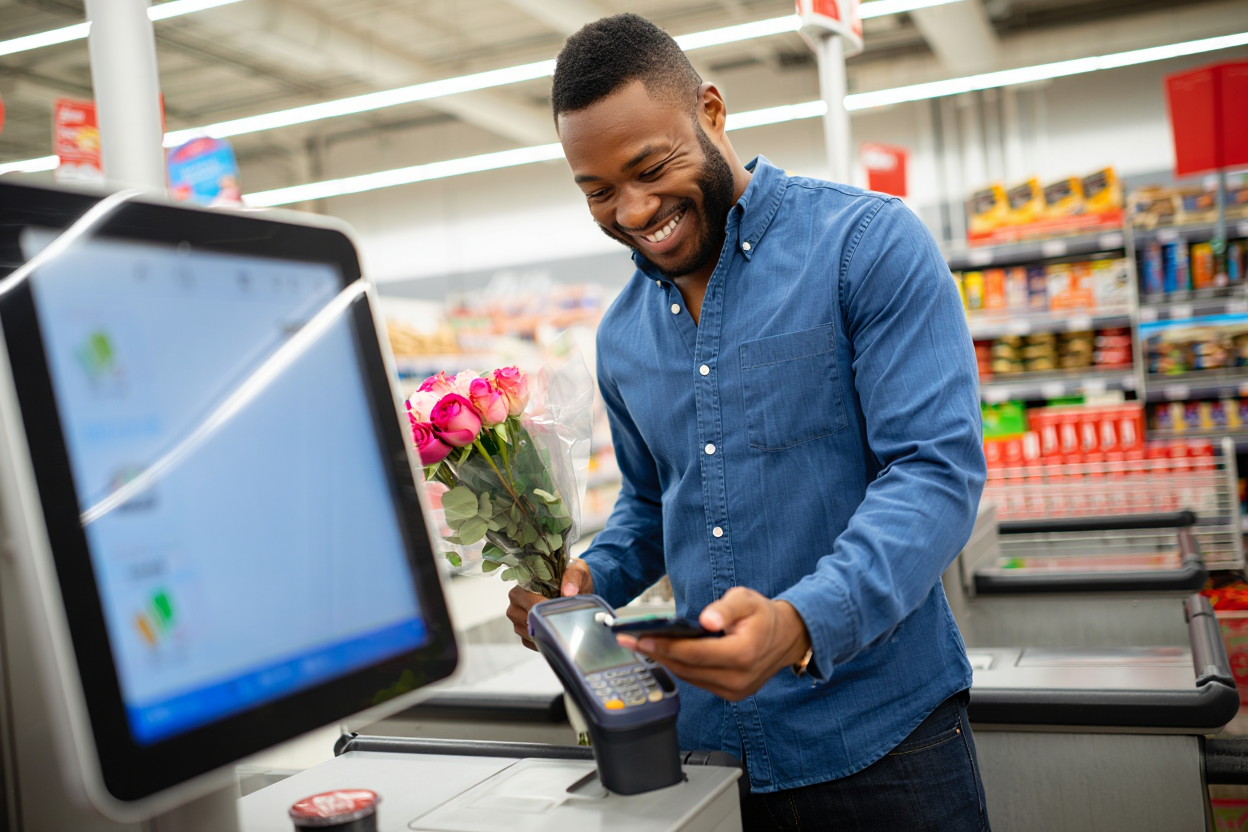
Customers expect speed. The latest self-checkout and scan-and-go technology, combined with modern payment hardware, dramatically shortens lines without forcing you to staff up. EMV, tap-to-pay, mobile wallets, EBT/SNAP processing, and WIC integration all run on a single unified terminal, no more juggling separate devices or workarounds.
For ethnic and specialty grocers, this matters even more. Today's POS systems handle complex tax rules, age-restricted items, scale integration for deli and produce, and multi-language receipt printing without breaking a sweat.
Unified Back-Office and Store IT
The POS is just the front door. What's running behind it matters just as much.
Modern grocery technology stacks tie your POS, payment processing, scale systems, electronic shelf labels, loyalty platform, online ordering, and accounting into a single cloud-based dashboard. You can check sales, labor cost, top movers, and cash position from your phone, whether you're at the store, at home, or on vacation.
Equally important: secure, PCI-compliant network infrastructure. AI-enabled cameras, IoT scales, and connected refrigeration units all live on your store network now. A weak network is a security liability and an operational one. Reliable Wi-Fi, segmented networks, managed firewalls, and 24/7 monitoring are no longer optional; they're foundational.
What This Means for Independent Grocers in NJ and NYC
The grocery operators winning today aren't the ones with the biggest budgets; they're the ones running the smartest stack. AI-enabled POS, real-time inventory, dynamic pricing, personalized loyalty, and a hardened store network are no longer reserved for Kroger or Whole Foods. The technology is available, affordable, and proven for independent supermarkets right now.
At QSS, we've spent over 50 years helping grocers across New Jersey and the New York metro area modernize their POS and store IT, without ripping out everything you've built. We deploy and support AI-enabled platforms, plus the network, security, and back-office infrastructure that holds it all together.
If your current system is more than three years old, it's time for a real conversation about what AI-driven grocery technology could do for your margins.
Ready to see what a modern grocery POS could look like in your store?
#NYCGroceryPOS #NJGroceryPOS #GroceryPOS #SupermarketPOS #AIPOS #GroceryTechnology #SupermarketTechnology #IndependentGrocer #ShrinkPrevention #LossPrevention #InventoryManagement #DemandForecasting #DynamicPricing #SelfCheckout #ScanAndGo #EBTSNAP #WICProcessing #GroceryLoyalty #StoreIT #POSUpgrade #GroceryMargins #NJSmallBusiness #NYCSmallBusiness