

Self-Checkout for Small Grocery Stores: Is It Worth It, and What Does It Really Cost ?
Introduction
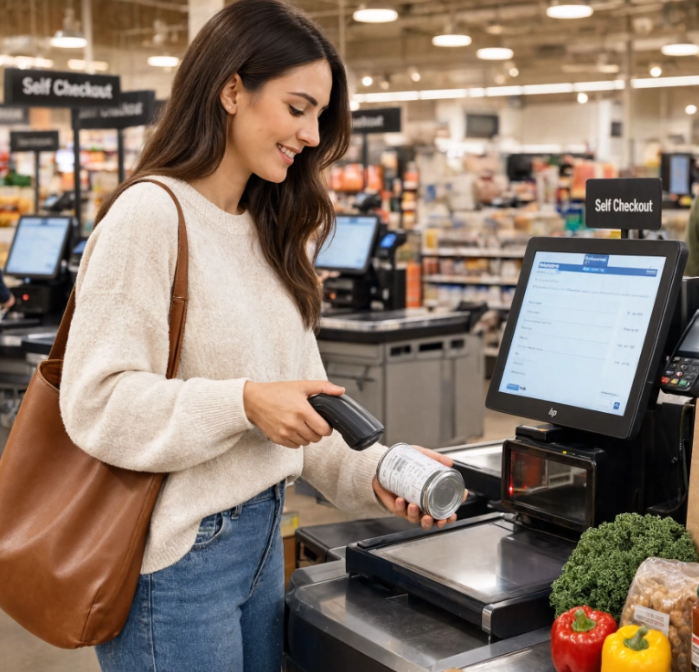
Walk into almost any major supermarket today, and you'll likely find customers scanning and paying for their groceries at self-checkout stations. What was once considered a convenience reserved for large national chains has steadily become an option for independent grocery stores looking to improve efficiency, reduce wait times, and better serve today's shoppers.
For many small grocery store owners, however, deciding whether to invest in self-checkout isn't always straightforward. While the technology promises faster service and potential labor savings, it also raises important questions about setup costs, ongoing maintenance, customer adoption, and shrinkage. Business owners want to know whether the investment will genuinely improve operations or simply introduce new challenges.
The answer depends on much more than the price of the equipment. A successful self-checkout implementation requires the right POS system, reliable payment processing, secure network infrastructure, employee training, and ongoing technical support. When these components work together, self-checkout can improve operational efficiency and customer satisfaction. Without proper planning, however, the return on investment may take longer than expected.
Self-checkout is not the right fit for every grocery store, so transaction volume, available floor space, customer demographics, and staffing needs should be evaluated before making an investment.
This guide explores what small grocery stores should know before investing in self-checkout technology, including the real costs involved, potential business benefits, common challenges, and the factors that determine whether self-checkout is the right fit for your store.
What Is a Self-Checkout System and How Does It Work?
Self-checkout is more than simply replacing a cashier with a touchscreen. Modern self-checkout systems combine hardware, software, payment processing, barcode scanning, and POS technology into one integrated solution that allows customers to complete purchases independently while store employees oversee multiple checkout stations.
Unlike traditional checkout lanes that require one employee for every register, self-checkout allows a single staff member to assist several customers at once. Employees remain available to verify age-restricted purchases, resolve scanning issues, answer customer questions, and provide assistance when needed, while customers complete much of the checkout process themselves.
For small grocery stores experiencing staffing challenges or growing customer traffic, this approach can improve operational flexibility without sacrificing customer service.
Key Components of a Self-Checkout System
Although systems vary by provider, most self-checkout solutions include several core components that work together to create a smooth checkout experience.
These typically include barcode scanners, customer-facing touchscreens, payment terminals, receipt printers, cash management options where applicable, security monitoring tools, and software that integrates directly with the store's POS platform.
Because every transaction flows through the POS system, selecting compatible technology is essential. Businesses using modern platforms often benefit from real-time inventory updates, centralized reporting, and easier management across all checkout lanes.
How Self-Checkout Integrates with Your POS
A self-checkout station should never operate as a standalone system. Instead, it should function as an extension of your existing POS environment.
When integrated correctly, every transaction updates inventory automatically, records sales data, applies promotions, processes loyalty rewards, and generates accurate reporting without requiring additional manual work.
Stores using modern cloud-based POS systems often find these integrations easier to manage because updates, reporting, and software improvements can be handled centrally across multiple checkout stations.
This integration not only simplifies daily operations but also gives managers better visibility into sales trends, inventory movement, and overall store performance.
For grocery stores that accept SNAP EBT or WIC, self-checkout integration requires additional planning. Eligible and non-eligible items must be identified correctly, approved benefits must be applied accurately, and split-tender transactions may need to move smoothly between benefits. cards and other payment methods. WIC transactions can involve additional product eligibility and authorization requirements, making POS compatibility especially important for independent grocery stores serving New Jersey and New York City communities.
Why Small Grocery Stores Are Investing in Self-Checkout
Self-checkout is no longer viewed as a technology reserved for national supermarket chains. Independent grocery stores are increasingly adopting these systems because they address several operational challenges simultaneously.
Rising labor costs, ongoing staffing shortages, changing customer expectations, and increasing transaction volumes have encouraged many store owners to rethink the traditional checkout model. Rather than replacing employees, self-checkout often allows businesses to use staff more efficiently while continuing to provide quality customer service.
For many stores, the goal isn't simply reducing payroll costs. It's creating a faster, more flexible shopping experience while improving overall operational efficiency.
Meeting Changing Customer Expectations
Today's shoppers value convenience as much as product selection.
Customers purchasing only a handful of items often prefer completing their transactions quickly without waiting behind larger grocery orders. Self-checkout provides that flexibility by giving customers another option while reducing congestion at staffed checkout lanes.
A faster checkout experience improves customer satisfaction, encourages repeat visits, and creates a more positive perception of the store during busy shopping periods.
What Does It Really Cost to Set Up a Self-Checkout System?
One of the first questions grocery store owners ask is simple: how much does a self-checkout system actually cost? As a planning estimate, a self-checkout station can range from approximately $10,000 to $30,000 or more per lane, depending on the hardware, payment technology, cash-handling requirements, security features, and POS integration involved. Installation, configuration, and integration may add several thousand dollars to the initial project, while software, support, and maintenance create ongoing operating costs. These figures are illustrative planning ranges rather than fixed QSS pricing, but they give store owners a more realistic starting point for budgeting.
Rather than viewing self-checkout as the purchase of a single machine, it's more accurate to think of it as an investment in your store's checkout ecosystem. Hardware, software, payment processing, network reliability, employee training, and ongoing support all contribute to the overall success of the implementation.
Hardware and Self-Checkout Equipment
The most visible part of any self-checkout solution is the hardware itself. Depending on your operational needs, this may include touchscreen kiosks, barcode scanners, payment terminals, receipt printers, cash handling devices, bagging areas, and security cameras or weight verification systems.
The number of stations required depends largely on customer traffic and store layout. A neighborhood grocery store may only benefit from one or two self-checkout stations, while a larger independent supermarket may require several to keep checkout lines moving efficiently during peak shopping hours.
Choosing reliable equipment from the beginning can reduce maintenance issues and extend the life of the system, making it a worthwhile long-term investment.
POS Software and System Integration
Hardware alone cannot deliver an effective self-checkout experience. Every station must communicate seamlessly with the store's POS system to ensure it processes transactions accurately and updates inventory in real time.
A properly integrated solution automatically applies discounts, updates inventory levels, tracks loyalty rewards, records sales data, and generates accurate reporting without requiring employees to manually reconcile transactions.
Stores operating on cloud-based POS systems often find integration simpler because they centralize updates, reporting, and software management. Cloud-based platforms also make it easier to scale operations as the business grows.
Network Infrastructure Matters More Than Many Owners Realize
Self-checkout systems rely on stable communication between payment terminals, POS software, inventory databases, and payment processors. Even the best equipment can experience delays if the underlying network is unreliable.
Before installing self-checkout, grocery store owners should evaluate whether their existing network can support additional connected devices while maintaining rapid transaction speeds.
A secure and reliable business network improves checkout performance and protects sensitive payment information from security threats. Businesses planning a self-checkout rollout should review their network infrastructure before installation rather than after problems begin to appear.Grocery stores that depend on connected checkout technology should also understand how POS system downtime affects store operations, especially when payment terminals, inventory systems, and checkout lanes rely on the same technology environment.
Installation, Configuration, and Employee Training
Installing self-checkout involves much more than assembling equipment.
Each station must be configured to communicate correctly with the POS system, payment processor, inventory software, pricing database, and store network. Testing every component before launch helps reduce operational issues and creates a smoother customer experience from day one.
Employee training is equally important. Staff should understand how to assist customers, resolve common scanning issues, verify age-restricted purchases, and troubleshoot basic technical problems. When employees feel confident using the technology, they can provide faster assistance while keeping checkout lines moving efficiently.
Ongoing Maintenance and Technical Support
Self-checkout is not a "set it and forget it" investment.
Like any business technology, it requires ongoing software updates, equipment maintenance, security monitoring, and technical support to perform reliably over time.
Working with an experienced technology partner helps businesses reduce unexpected downtime, keep systems current, and resolve issues before they significantly affect store operations. Ongoing support also ensures businesses can adapt as payment technology, security requirements, and customer expectations continue to evolve.
A Sample Two-Station Self-Checkout Budget
Consider a small independent grocery store planning to add two self-checkout stations. If each station costs approximately $15,000 for hardware and core equipment, the initial equipment investment would be about $30,000. POS integration, installation, network preparation, and employee training could add another $5,000 to $10,000 depending on the store's existing technology environment. The total initial project could therefore fall in the range of $35,000 to $40,000 or more.
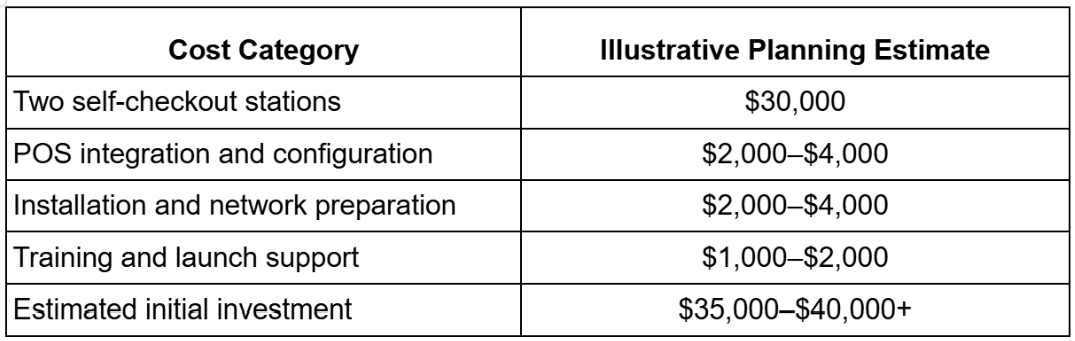
Actual costs vary based on equipment, store layout, existing POS infrastructure, payment requirements, and ongoing support needs. Grocery store owners should request a store-specific assessment before finalizing a budget.
Understanding the ROI of Self-Checkout
The decision to install self-checkout should not be based solely on equipment costs. The more important question is whether the investment creates measurable value for the business over time.
Return on investment depends on much more than labor savings. Improvements in customer experience, transaction capacity, operational efficiency, and checkout speed all contribute to the long-term value of self-checkout technology.
Store owners should also account for shrinkage, maintenance, and ongoing support costs when calculating the true return on investment.
For many independent grocery stores, the goal isn't replacing employees. Instead, it's enabling existing staff to focus on higher-value tasks while maintaining a faster and more efficient checkout experience.
Labor Savings Without Reducing Customer Service
One of the most frequently discussed advantages of self-checkout is labor efficiency.
Rather than assigning one cashier to every checkout lane, employees can supervise multiple self-checkout stations while assisting customers only when needed. This allows staff to spend more time stocking shelves, preparing online orders, helping shoppers locate products, or maintaining store presentation.
This approach helps grocery stores improve operational flexibility without sacrificing customer service, especially during periods when hiring additional employees is difficult.
Increased Checkout Capacity During Busy Hours
Checkout congestion is one of the biggest challenges facing grocery stores during evenings, weekends, and holiday shopping periods.
Adding self-checkout stations increases the number of available checkout points without requiring the same number of additional cashiers. Customers purchasing only a few items can complete their transactions more quickly, reducing wait times for everyone in the store.
Improved checkout capacity not only enhances the shopping experience but also helps businesses process more transactions during peak traffic periods.
Better Customer Satisfaction and Convenience
Today's shoppers appreciate having choices.
Some customers prefer interacting with a cashier, while others value the speed and independence offered by self-checkout. Providing both options allows grocery stores to serve a wider range of customer preferences without forcing shoppers into a single checkout experience.
When implemented effectively, self-checkout can improve convenience, shorten queues, and encourage repeat visits from customers who value efficiency.
Looking Beyond Immediate Financial Returns
The return on investment from self-checkout is not measured only in payroll savings.
Businesses should also consider benefits such as the following:
Improved customer satisfaction
Faster transaction times
Increased checkout capacity
Better staff productivity
Reduced queue lengths
Greater operational flexibility
When viewed together, these improvements often deliver value that extends well beyond direct cost savings.
For grocery store owners, the most successful self-checkout implementations are those that balance technology, employee support, and customer experience. Businesses that plan carefully, invest in reliable infrastructure, and choose solutions that integrate with their existing POS environment are more likely to achieve long-term operational improvements and a stronger return on their investment.
What Could Self-Checkout Payback Look Like?
Consider the same grocery store with an illustrative $40,000 self-checkout investment. If the new checkout setup allows the business to reallocate 40 cashier hours per week to stocking, online order fulfillment, customer assistance, and other operational tasks, the value of those reallocated hours can become meaningful over time.
At an illustrative labor cost of $18 per hour, 40 hours represents $720 per week, or approximately $37,440 annually. Based on labor efficiency alone, a $40,000 technology investment could approach its initial cost within roughly 13 months.
This is not a guaranteed ROI calculation. Shrinkage, maintenance, software costs, transaction volume, and actual staffing decisions all affect payback. However, a worked example helps grocery store owners compare the investment against measurable operational improvements rather than evaluating hardware costs in isolation.
What Retail Data Says About Self-Checkout
Self-checkout adoption has grown significantly, but the results have not been universally positive. Industry data shows why grocery store owners should evaluate both convenience and loss prevention before expanding self-service checkout.
Research highlighted by the Wharton School estimates self-checkout shrink rates at approximately 3.5% to 4%, compared with less than 1% for cashier-operated checkout. ECR Retail Loss research also reports that self-checkout now processes a significant share of grocery transactions and may contribute up to 23% of total unknown retail losses. Two-thirds of retailers surveyed by ECR said self-checkout losses were increasing.
These concerns have caused several major retailers to rethink how they use the technology. Dollar General significantly reduced self-checkout availability in thousands of stores, while retailers including Target and Walmart have tested item limits and other restrictions. At the same time, industry investment has not disappeared. A 2024 RIS News and IHL Group report cited by EMARKETER found that 30% of U.S. and Canadian retailers planned major self-checkout upgrades within the following two years.
The lesson for independent grocery stores is not that self-checkout has failed. It is that successful deployment requires tighter controls, active employee supervision, and a checkout strategy designed around the store's transaction patterns and customer base. Adding kiosks without addressing shrinkage and customer flow can create new costs instead of delivering the expected return.
The Hidden Costs Grocery Store Owners Should Consider
Self-checkout offers clear advantages, but like any business investment, it comes with responsibilities. Grocery store owners who evaluate only the potential labor savings may overlook operational factors that influence long-term success.
The good news is that proper planning, employee training, and the right technology partner can help you manage most of these challenges. Understanding them before implementation allows businesses to make informed decisions and avoid unexpected surprises after launch.
Shrinkage and Loss Prevention
Shrinkage is often the first issue that grocery store owners mention when discussing self-checkout. Because customers scan and bag their items, there is naturally a greater opportunity for missed scans, incorrect barcode entries, or intentional theft.
However, shrinkage should not be viewed as an unavoidable consequence of self-checkout. Modern systems include various security features designed to reduce risk, including weight verification, barcode validation, security cameras, transaction monitoring, and employee alerts when unusual activity occurs.
Technology alone is not enough. Store layout, employee engagement, and customer awareness all contribute to successful loss prevention. Employees who actively monitor self-checkout stations and assist customers often help reduce accidental mistakes and intentional theft.
Customer Assistance Still Matters
One common misconception is that self-checkout eliminates the need for employees.
In reality, customers still require assistance from time to time. Age-restricted purchases, pricing questions, barcode issues, payment errors, and loyalty program concerns all require staff intervention.
Rather than replacing employees, self-checkout changes their role. Instead of standing behind a single register, staff members become customer support specialists who help multiple shoppers complete transactions efficiently.
Stores that continue providing friendly assistance while offering self-checkout often achieve higher customer satisfaction than businesses that expect customers to manage the process entirely on their own.
Managing Age-Restricted Purchases at Self-Checkout
Alcohol, tobacco, and other age-restricted products require a clear employee verification workflow at self-checkout. The system should pause the transaction when a restricted item is scanned and alert an authorized employee to verify identification before the sale continues. Staff should understand when manual approval is required, how to handle rejected identification, and when a customer should be redirected to a staffed lane. For grocery stores in New Jersey and New York City, these workflows should align with applicable state and local sales requirements rather than relying on the kiosk to complete the transaction independently.
Equipment Maintenance and Software Updates
Like every technology investment, self-checkout systems require ongoing maintenance to perform reliably.
Routine software updates improve performance, address security vulnerabilities, and introduce new features that enhance the customer experience. Hardware components such as scanners, payment terminals, receipt printers, and touchscreens also require periodic inspection and maintenance to minimize downtime.
Businesses that postpone maintenance may eventually experience slower transactions, equipment failures, or unnecessary service interruptions that affect both employees and customers.
Store Layout and Customer Flow
Installing self-checkout may require changes to the checkout area itself.
Store owners should evaluate customer traffic patterns, available floor space, queue management, and accessibility before installation. A poorly positioned self-checkout station can create congestion instead of reducing it.
Well-designed layouts guide customers naturally through the checkout process while allowing employees to monitor multiple stations without difficulty. Planning the physical layout before installation helps maximize both operational efficiency and customer convenience.
Accessibility should also be considered during kiosk selection and layout planning. Self-checkout stations should provide usable controls and screens for customers with disabilities, while checkout areas need sufficient clear space for wheelchair access and customer movement. Screen placement, reach ranges, payment terminal positioning, and accessible lane design should be reviewed as part of the installation process rather than treated as an adjustment after launch.
Space planning is particularly important for New York City grocery stores, where narrow storefronts and compact checkout areas can make a traditional multi-kiosk layout impractical. A smaller-format store may benefit from one or two carefully positioned self-checkout stations instead of a large rollout. New Jersey suburban grocery stores with larger footprints may have more flexibility to create dedicated self-checkout zones and queue areas. The right layout should reflect the physical realities of the store rather than copying a national supermarket model.
Does Self-Checkout Improve the Customer Experience?
Customer experience is one of the strongest reasons many grocery stores invest in self-checkout technology. While cost savings often receive the most attention, shoppers generally evaluate a store based on convenience, speed, and ease of use.
When implemented correctly, self-checkout provides another option rather than replacing traditional cashier-operated lanes. This flexibility allows customers to choose the checkout experience that best matches their shopping preferences.
Faster Checkout for Smaller Purchases
Many grocery customers purchase only a few items and prefer completing their transactions as quickly as possible.
Instead of waiting behind larger grocery orders, they can scan, pay, and leave within minutes. During busy shopping periods, this additional checkout option helps reduce congestion while improving the overall shopping experience for everyone in the store.
Shorter wait times not only improve convenience but also encourage repeat visits from customers who value efficiency.
Providing Choice Instead of Replacing Service
Not every customer wants to use self-checkout.
Some shoppers appreciate the personal interaction of a cashier, while others prefer completing transactions independently. The most successful grocery stores recognize that both preferences are valid and provide multiple checkout options.
Offering traditional checkout lanes alongside self-checkout allows businesses to accommodate different customer demographics while maintaining high service standards.
Building Confidence Through Simplicity
A successful self-checkout experience should feel intuitive.
Clear on-screen instructions, responsive barcode scanners, reliable payment processing, and accessible employee assistance all contribute to customer confidence.
The easier the system is to use, the more likely customers are to adopt it during future visits.
Is Self-Checkout Right for Every Small Grocery Store?
Although self-checkout continues growing in popularity, it is not automatically the right solution for every business.
Before making an investment, grocery store owners should carefully evaluate their operational needs rather than following industry trends alone.
Consider Your Daily Transaction Volume
Stores with consistently high customer traffic often see the greatest operational benefits because additional checkout capacity helps reduce queues during peak periods.
Businesses with lower transaction volumes may not experience the same return on investment, particularly if traditional checkout lanes already meet customer demand efficiently.
Evaluate Available Floor Space
Self-checkout stations require adequate space for equipment, customer movement, queue management, and employee supervision.
Installing additional checkout stations without considering overall store layout can negatively affect customer flow and create unnecessary congestion.
Planning ahead helps ensure new technology improves rather than complicates daily operations.
Understand Your Customer Demographics
Every customer base is different.
Customer adoption also varies by community. Some shoppers readily use self-service technology, while others prefer face-to-face interactions with store employees.
Understanding customer preferences helps you decide how many self-checkout stations to install and whether a phased implementation is more appropriate than a full rollout.
Think Beyond Today's Needs
Technology investments should support future business growth as well as current operations.
Choosing scalable solutions allows grocery stores to expand checkout capacity, integrate additional payment options, and adopt new technology without replacing their entire POS environment.
Businesses planning long-term growth benefit from flexible systems that evolve alongside changing operational requirements.
Best Practices for a Successful Self-Checkout Implementation
Installing self-checkout is only the beginning. Long-term success depends on careful planning, ongoing management, and continuous improvement.
Businesses that approach implementation strategically are more likely to achieve stronger operational results and higher customer satisfaction.
Choose Technology That Supports Growth
Selecting the right POS platform is one of the most important decisions in any self-checkout project.
Modern cloud-based POS systems simplify reporting, inventory management, software updates, and system scalability while making it easier to manage multiple checkout stations from one centralized platform.
Build a Reliable and Secure Technology Foundation
Before launch, test every self-checkout station under realistic transaction loads and confirm that payment terminals, POS software, and inventory systems remain responsive during peak periods. Document a response plan for connectivity failures so employees know when to redirect customers to staffed lanes and who to contact for technical support.
Protecting connected checkout systems also requires a broader security strategy, which is why grocery store owners should understand the fundamentals covered in Cybersecurity 101 for small businesses.
Train Employees for Success
Employee confidence plays a significant role in customer adoption.
Training should focus not only on operating the equipment but also on assisting customers, resolving common issues, monitoring transactions, and maintaining a positive checkout experience.
Knowledgeable employees help customers feel comfortable using self-checkout while minimizing operational disruptions.
Monitor Performance and Make Improvements
Successful implementations continue evolving after launch.
Businesses should regularly review transaction times, customer feedback, shrinkage reports, equipment performance, and employee observations to identify opportunities for improvement.
Regular performance reviews and targeted adjustments improve efficiency, customer satisfaction, and overall return on investment.
How QSS Helps Grocery Stores Implement Self-Checkout Successfully
Investing in self-checkout is about more than purchasing new equipment. Long-term success depends on selecting the right technology, ensuring every component works together, and having ongoing support after installation. Grocery store owners need a solution that improves daily operations while remaining reliable as their business grows.
QSS has helped grocery stores, convenience stores, and retailers throughout New Jersey and New York City modernize their checkout environments with integrated POS and payment solutions. Rather than recommending a one-size-fits-all approach, QSS evaluates each business's transaction volume, store layout, staffing requirements, and long-term goals to recommend technology that aligns with its operational needs.
Implementing Reliable Self-Checkout Solutions
Every grocery store operates differently, which is why self-checkout should never be treated as a standard installation. QSS works closely with business owners to determine the right number of self-checkout stations, optimize store layouts, and ensure the new system integrates seamlessly with existing POS software and inventory management tools.
By carefully planning each deployment, grocery stores can improve checkout efficiency while minimizing disruption during implementation.
Supporting Trusted POS and Payment Technologies
Self-checkout performs best when dependable technology powers it. QSS helps businesses implement solutions powered by trusted platforms such as Clover and Shift4, giving store owners access to secure payment processing, centralized reporting, and modern POS capabilities.
These technologies help grocery retailers simplify operations, improve transaction reliability, and provide customers with a faster and more convenient checkout experience.
Providing Ongoing Local Support
Technology continues to evolve after installation, making long-term support just as important as the initial setup.
QSS provides ongoing assistance with software updates, equipment maintenance, troubleshooting, and system optimization so businesses can continue operating with confidence. Having access to experienced local support helps grocery stores resolve issues quickly while reducing the likelihood of extended operational disruptions.
A Unified Technology Strategy for Long-Term Growth
As grocery stores adopt more connected technologies, managing separate vendors for POS systems, payment processing, networking, and IT support becomes increasingly complex.
A unified technology strategy helps businesses simplify operations by ensuring every system works together as a single solution rather than a collection of disconnected tools. This approach not only improves reliability but also reduces management complexity and creates a stronger foundation for future growth.
Conclusion: Is Self-Checkout Worth the Investment?
For many small grocery stores, self-checkout is no longer simply a convenience feature. It has become a practical way to improve operational efficiency, increase checkout capacity, and meet changing customer expectations.
The value of self-checkout, however, extends beyond labor savings. Faster checkout experiences, improved customer satisfaction, better staff utilization, and increased operational flexibility all contribute to the long-term return on investment. At the same time, grocery store owners must carefully evaluate factors such as shrinkage, ongoing maintenance, employee training, and technology support before making a purchasing decision.
Businesses that approach implementation strategically are far more likely to achieve successful outcomes. Choosing reliable POS technology, building a secure network infrastructure, training employees effectively, and working with an experienced technology partner all play an important role in maximizing the value of a self-checkout investment.
Rather than asking whether self-checkout is right for every grocery store, the better question is whether the solution has been planned and implemented correctly. With the right strategy, self-checkout can become an important tool for improving customer experience while supporting long-term business growth.
Frequently Asked Questions
How much does it cost to install a self-checkout system in a small grocery store?
As a general planning estimate, a self-checkout station may cost approximately $10,000 to $30,000 or more per lane, depending on hardware, cash-handling features, payment technology, security tools, and POS integration. Installation, network preparation, configuration, training, and ongoing software or support costs should also be included in the budget. For example, an illustrative two-station deployment could require an initial investment of roughly $35,000 to $40,000 or more. Actual QSS project pricing depends on the store's existing technology and operational requirements.
Can self-checkout reduce labor costs?
Self-checkout can improve labor efficiency by allowing one employee to supervise multiple checkout stations while assisting customers as needed. Rather than replacing staff, many grocery stores use self-checkout to free employees for higher-value tasks such as stocking shelves, fulfilling online orders, and improving customer service throughout the store.
Does self-checkout increase shoplifting?
Shrinkage is a consideration for any self-checkout implementation, but modern systems include features designed to reduce risk. Weight verification, transaction monitoring, security cameras, and employee oversight all help improve accuracy while discouraging theft. Proper training and store layout also contribute significantly to effective loss prevention.
How many self-checkout stations does a small grocery store need?
The ideal number depends on customer traffic, store size, available floor space, and checkout demand during peak shopping periods. Some neighborhood grocery stores benefit from a single station, while others may require several to improve customer flow and reduce waiting times.
Can self-checkout work with my existing POS system?
Many modern self-checkout solutions integrate with existing POS platforms, although compatibility depends on the software and hardware currently in use. An experienced technology provider helps businesses evaluate their existing systems and determine whether they need upgrades or additional integrations before installation.
How long does it take to install a self-checkout system?
Installation timelines vary depending on store size, network readiness, system configuration, and employee training requirements. A properly planned implementation includes equipment setup, software integration, testing, and staff education to ensure the system operates smoothly before customers begin using it.
What types of grocery stores benefit most from self-checkout?
Stores with moderate to high transaction volumes often experience the greatest operational benefits. Grocery stores serving customers who frequently purchase smaller baskets may also find that self-checkout improves checkout speed, reduces congestion, and creates a more convenient shopping experience.
How can QSS help implement self-checkout?
QSS helps grocery stores evaluate, install, and support self-checkout solutions that integrate with trusted POS and payment technologies such as Clover and Shift4. From planning and deployment to ongoing maintenance and technical support, QSS collaborates with businesses to enhance checkout efficiency and ensure long-term operational success.
Modernize Your Checkout Experience with Confidence
The right self-checkout solution can do more than reduce wait times. It can improve operational efficiency, support employees, enhance customer satisfaction, and prepare your grocery store for future growth.
QSS helps independent grocery stores throughout New Jersey and New York City evaluate, implement, and support self-checkout solutions that integrate seamlessly with modern POS systems and secure payment technology. Whether you're exploring self-checkout for the first time or planning to upgrade your current checkout environment, our team can help you choose a solution that aligns with your business goals.
Contact QSS today to schedule a consultation and discover how self-checkout can help improve your store's efficiency, customer experience, and long-term profitability.