

2026 POS Technology Trends Every Restaurant and Retail Owner Must Understand
Point-of-sale (POS) systems are no longer transactional tools. They have evolved into mission-critical platforms that influence revenue, labor efficiency, customer experience, fraud prevention, and long-term competitiveness. For restaurant and retail owners, understanding where POS technology is heading is no longer optional, it is foundational to operating profitably in 2026 and beyond.
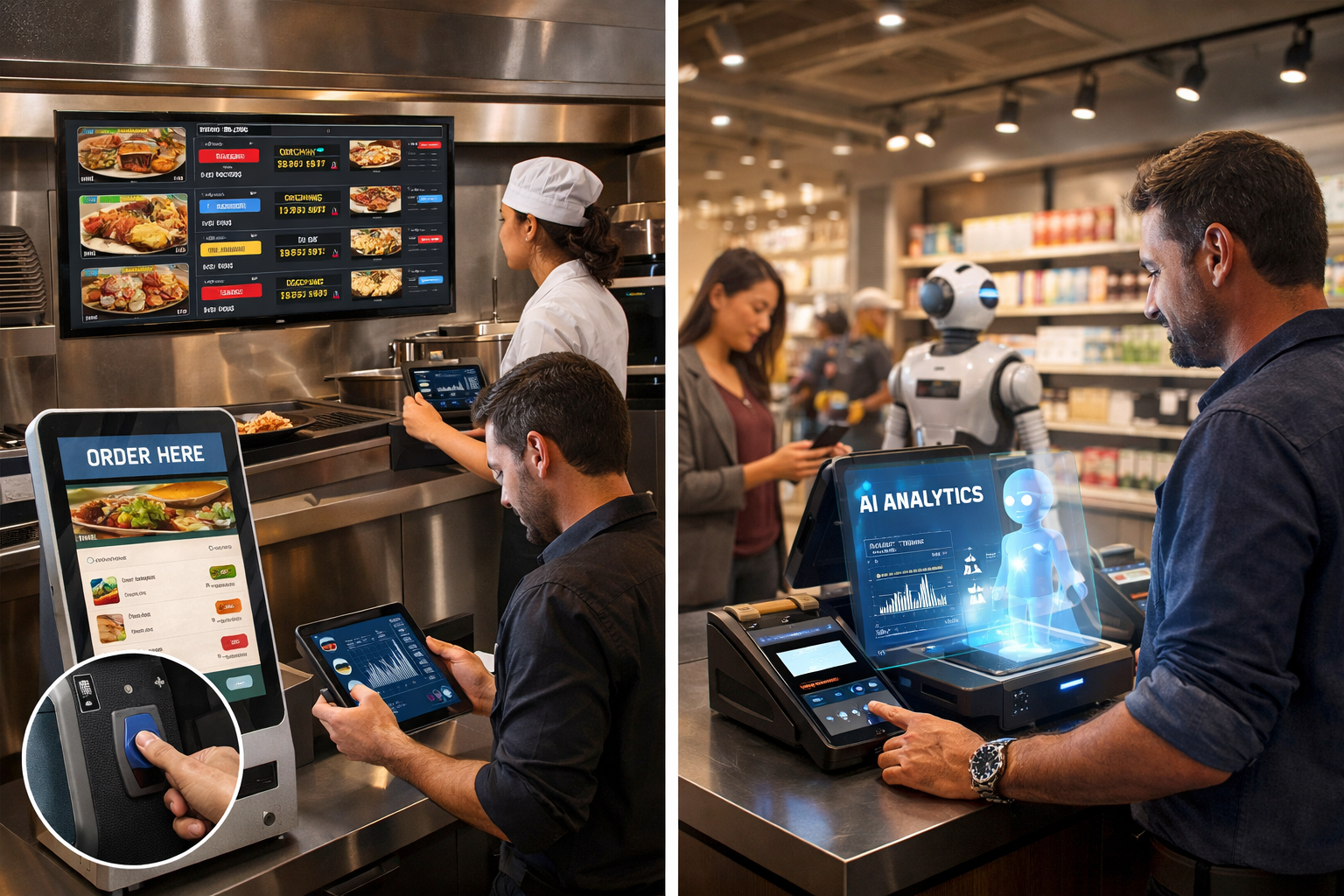
Below are the most consequential POS technology trends shaping the industry globally, followed by the specific implications for restaurants and retailers.
1. Cloud POS Is Now the Default, Not the Upgrade
Cloud-based POS adoption has crossed a tipping point. With the global cloud POS market growing at a rapid pace, legacy on-premise systems are increasingly becoming operational liabilities rather than assets.
Cloud POS platforms enable real-time access to sales, inventory, and performance data across locations, devices, and channels. Unlike traditional systems tied to physical servers and local networks, cloud solutions offer operational flexibility, faster deployment, and lower upfront costs through subscription-based pricing models.
For business owners, the implication is clear: POS systems are becoming infrastructure-light but data-heavy. Cloud adoption is no longer about convenience, it is about scalability, resilience, and future-proofing. However, cloud migration must be intentional. Internet reliability, security architecture, and system design must align with the business model to avoid downtime risks.
2. POS Data, AI, and Automation Are Converging
Modern POS systems increasingly embed analytics, machine learning, and AI-driven insights directly into daily operations. What once required external reporting tools is now native to advanced POS platforms.
AI-enabled POS systems support:
Demand forecasting and sales pattern recognition
Automated inventory and labor optimization
Real-time performance and anomaly detection
Personalized promotions and customer segmentation
As data volumes grow, AI is no longer a “nice-to-have” but a necessity for extracting value from transactional data. Businesses that fail to leverage these capabilities risk operating reactively, while competitors make predictive, data-driven decisions.
At the same time, regulatory and privacy considerations (GDPR, CCPA) make secure data governance non-negotiable. AI-driven POS benefits must be balanced with compliance, transparency, and responsible data usage.
3. POS Hardware Is Becoming Smarter, More Mobile, and More Automated
The physical layer of POS technology is undergoing significant transformation. Traditional fixed terminals are being replaced or supplemented by mobile, modular, and self-service hardware.
Key hardware trends include:
Kitchen Display Systems replacing printers to improve speed and accuracy
Self-service kiosks and tablets reducing labor dependency
Bluetooth-connected peripherals enabling mobile checkout
Rapid adoption of contactless and chip-based payments as swipe transactions decline
For both restaurants and retailers, hardware decisions are now strategic. Each upgrade impacts throughput, staffing models, loss prevention, and customer experience. The wrong hardware stack can introduce security risks, training complexity, or workflow friction—while the right one can unlock measurable operational gains.
4. Payment Diversity Is Expanding, and So Is Complexity
Payment acceptance is no longer just about cards. Modern POS systems must support an expanding mix of credit, debit, digital wallets, contactless payments, and emerging alternatives.
While offering more payment options improves conversion and customer satisfaction, it also introduces backend complexity. Funds may settle into multiple accounts, fees vary by method, and reconciliation becomes more difficult without robust reporting.
As payment ecosystems fragment, POS reporting accuracy becomes critical—not just for accounting, but for tax compliance, margin tracking, and fraud detection. Businesses that underestimate this complexity often feel the pain during audits or cash flow reviews.
5. Security, Biometrics, and Fraud Prevention Are Moving Upstream
Security is no longer confined to payment processing. POS systems are increasingly incorporating biometric authentication, user-level permissions, and behavioral monitoring to reduce internal fraud and unauthorized access.
Biometric login methods—such as fingerprint or facial recognition—add a layer of accountability that passwords cannot match. When combined with AI-based pattern detection, POS platforms can surface irregular behavior before losses escalate.
For owners, this represents a shift: POS security is becoming proactive rather than reactive. The cost of ignoring these capabilities grows as transaction volumes, payment methods, and staffing complexity increase.
6. AI Agents Are Emerging as the Next POS Layer
AI agents represent the next phase of POS evolution. Unlike traditional analytics, AI agents continuously monitor POS data streams to identify trends, risks, and opportunities without manual prompting.
Early implementations include:
Automated fraud and anomaly detection
Intelligent self-service ordering and voice assistants
Dynamic pricing and personalized promotions
While still early, AI agents are moving quickly from experimentation to competitive advantage. Businesses that adopt them early gain operational leverage; those that wait may struggle to catch up.
What This Means for Restaurants and Retailers
For restaurants, POS systems are increasingly integrated with online ordering, delivery platforms, table management, and self-service workflows. For retailers, POS platforms now anchor omnichannel strategies, inventory optimization, and return management.
Across both industries, the conclusion is the same: POS technology is no longer a back-office decision. It is a strategic system that directly influences profitability, scalability, and resilience.
The Bottom Line
POS systems have evolved into intelligent operating platforms. Cloud infrastructure, AI-driven analytics, advanced hardware, diversified payments, and automation are converging faster than many business owners realize.
The question for 2026 is not whether to modernize your POS, but how intentionally you do it. Businesses that align POS innovation with real operational goals will gain leverage. Those that delay risk being constrained by systems that can no longer keep up with how commerce actually works.